Why Most Industrial Solar Charge Controller Orders Are Over-Specced
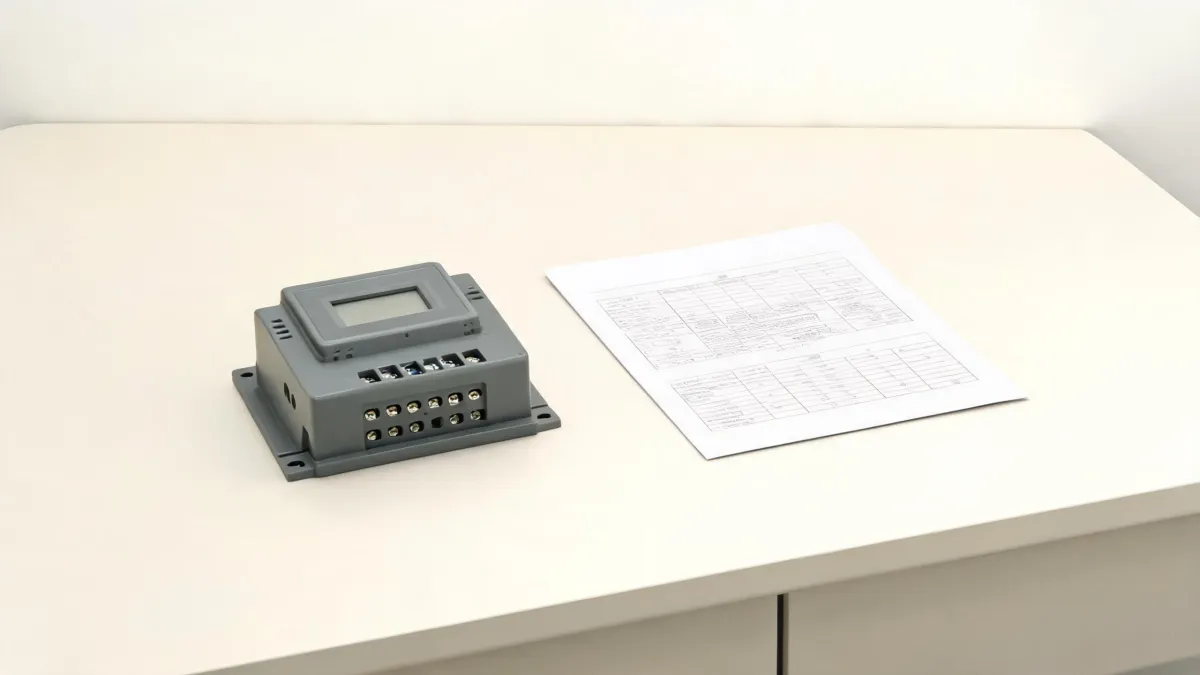
The Default That Costs More Than It Protects
About seven out of every ten wholesale solar charge controller orders I review come in specified as "industrial-grade." At least two of those ten don't need it. That's not a knock on industrial controllers—they're the right call for a real category of applications. But defaulting to the industrial spec because "more rugged is safer" is one of the quietest ways to waste a project budget, and it's everywhere in B2B sourcing right now.
I've been doing quality and brand compliance work for over four years. In that time, I've signed off on roughly 340 controller batches and sent back somewhere north of 40. What I've learned about over-specifying didn't come from a spreadsheet. It came from comparing two order categories side by side and realizing the difference wasn't doing what the buyers thought it was doing.
What Over-Speccing Actually Costs
In early 2024, I pulled two years of inspection records for our commercial-grade line and our industrial solar charge controller line. Same supplier groups, similar order volumes, similar destinations. I wanted to know if the industrial units were giving us measurably fewer quality rejections.
They weren't. Rejection rates came out at 3.1% for industrial and 3.4% for commercial. I've stared at those numbers long enough to conclude they're statistically indistinguishable. What was distinguishable: the industrial units averaged about 11 days longer lead time and cost $28–$40 more per unit.
On a 100-unit run, that's roughly $3,000–$4,000 in pure spec premium for a quality difference I can't prove exists. That money could have bought improved surge protection, better cable terminations, or an extra battery of site testing—all of which showed up repeatedly in our actual failure data. Instead, it went into headroom that nobody used.
And the premium is only part of it. Industrial controllers usually need different mounting hardware, more enclosure clearance for thermal dissipation, or a different wiring configuration. Last year, a 60-unit deployment cost us about two and a half additional electrician days just to rework the enclosure spacing after the units arrived. That line item never appears in the spec comparison, but it's real. If you've ever had to re-drill a backplate because the controller was 8mm wider than the old one, you know that hour is not coming back.
Where More Headroom Actually Hurts
Here's the part that gets pushback from buyers who've been burned by under-spec'd units before. Under-specification is a genuine failure mode—I've rejected batches for it. But over-specification has its own failure profile, and it's less obvious because nothing breaks.
Industrial controllers often run a narrower low-end MPPT window. If your array wiring was sized for a commercial-grade unit with a wider voltage range, an industrial controller can actually clip earlier in the morning and drop off earlier in the evening. You paid a premium for a unit that delivers fewer usable harvest hours on a specific array topology. That's not a defect—it's a mismatch. But it's common enough that I now flag certain configurations automatically when I see the spec.
In Q3 2024, we had a batch of 80 controllers queued for shipment where the operating window didn't align with the documented array configuration. On paper, they were "better." In practice, they were wrong for the job. Catching it before the units left the dock saved us roughly $6,800 in expedited freight and a two-week rework—but the only reason we caught it is that I've started cross-checking array voltage windows against the controller's low-end MPPT range as a standard step. Most buyers don't have that cross-check built into their procurement process.
The Moment My Gut and the Spreadsheet Disagreed
Last Q2, I ran the numbers on consolidating our entire medium-volume book under a single industrial-grade SKU. The math was clean: a meaningful tiered discount, simpler inventory, fewer SKUs to track. Everything pointed to yes.
My gut said no. The lead times on that specific product family had been creeping up for months, and the consolidated order would have locked us into a single fulfillment queue. We split the order instead. The discount shrank by about 40%, but on-time delivery held. Two months later, a contact at another solar charge controller supplier mentioned they'd run into the same capacity bottleneck on the same SKU. The cost model had assumed availability, not priority. That assumption is expensive when it breaks.
"But What if My Loads Grow?"
This is the question I get most, and it's fair. If you're genuinely planning 30% expansion within 18 months, buying the larger controller today is probably correct. But if "maybe we'll expand" is the justification, you're paying today's premium against a future that may not arrive—and if it does, the rest of the system will likely need re-spec'ing anyway.
At BrightPath Supply, we've moved our wholesale solar charge controller specs toward documented load profiles instead of peak-with-margin estimates. It takes longer upfront. It also reduces returns and installer callbacks, which is the metric that actually reaches my desk. I'd rather spend three more meetings on spec review than three weeks on rework.
What Industrial-Grade Is Actually For
This is not a case against buying industrial solar charge controllers. I recommend them regularly—for specific conditions. Sustained ambient temperatures above 45°C. Continuous duty cycles where the unit rarely idles. Environments with known surge or vibration exposure. Sites where maintenance access is difficult enough that a field swap would cost more than the spec premium. In those settings, the industrial rating isn't over-engineering. It's the correct engineering.
The problem is treating a rating built for a specific set of failure conditions as a universal default. When you buy the industrial spec for every project across a wholesale solar charge controller order, you don't eliminate risk—you relocate it. The money moves from the equipment line to the parts of the project that needed it more.
What I Want to See in an RFQ
When I review incoming specifications now, three things tell me quickly whether the buyer did their homework: a documented load profile (not a guess labeled as a peak), a stated ambient temperature range, and a clear answer to "how fast can this unit be swapped if it fails?" When those three are answered, the industrial-or-commercial question mostly answers itself.
The buyers who get this right aren't the ones buying the most rugged unit on the market. They're the ones who can finish this sentence in one breath: "We specified this controller because our load profile and ambient conditions require it." If your procurement team can't finish that sentence, the standard unit is probably already covering you—and you're paying a premium for caution that never paid out. That's the over-speccing problem in a nutshell. Most industrial solar charge controller orders I see aren't wrong. They're just answering a question the project never asked.

Jane Smith
I’m Jane Smith, a senior content writer with over 15 years of experience in the packaging and printing industry. I specialize in writing about the latest trends, technologies, and best practices in packaging design, sustainability, and printing techniques. My goal is to help businesses understand complex printing processes and design solutions that enhance both product packaging and brand visibility.